

Planning a funeral or memorial service is something most families are never prepared for.
Grief arrives first. Then decisions follow — often quickly — while emotions are still close to the surface. You may be sorting through paperwork, fielding phone calls, comforting family members, and trying to make thoughtful choices at the same time.
If that’s where you are right now, take a breath.
There is no perfect way to do this. A Christian funeral or memorial service doesn’t need to be elaborate or flawless. Its purpose is simple: to honor a life, comfort those who grieve, and point hearts toward the hope we have in Christ.
This guide walks through the basics of what families typically encounter, what decisions usually arise, and what to expect along the way.
The Purpose of a Christian Funeral or Memorial Service
At its heart, a Christian funeral or memorial service serves three main purposes.
First, it honors the life of someone who mattered deeply. Stories are shared. Memories are remembered. Gratitude is expressed for the years God allowed.
Second, it brings comfort to those left behind. A service gathers family and friends into one space, reminding everyone that they do not walk through loss alone.
And third, it points toward eternal hope. Christian services gently acknowledge grief while also affirming the promise of resurrection, restoration, and life with Christ.
Whether the gathering is formal or simple, held in a church or at a graveside, these same purposes remain.
Different Families, Different Starting Points
Every family begins this process from a different place.
Some have planned ahead. Others are facing unexpected loss. Some are supported by a church community. Others feel unsure where to begin.
Many families are surprised by how quickly practical questions appear:
Where will the service be held?
Who will lead it?
What music should be included?
Will there be a visitation?
Should there be a graveside service?
If this feels overwhelming, that’s normal. Most people only walk through funeral planning a few times in life, and almost always during emotionally heavy seasons.
You don’t need to have everything figured out at once. Taking one step at a time is enough.

A Simple Picture of How Most Services Usually Flow
While every service is unique, many Christian funerals and memorial services follow a similar overall pattern.
At a basic level, the flow often looks something like this:
- A welcome or opening prayer
- Scripture readings
- One or more songs or hymns
- Reflections or shared memories
- A brief message or devotional thought
- Closing words and prayer
- Graveside service, if applicable
Some services are held entirely at a church or funeral home. Others include a graveside portion afterward. Some families choose a memorial service days or weeks later, especially if cremation is involved.
The exact order and length vary, but most services move gently between remembrance, worship, and comfort.
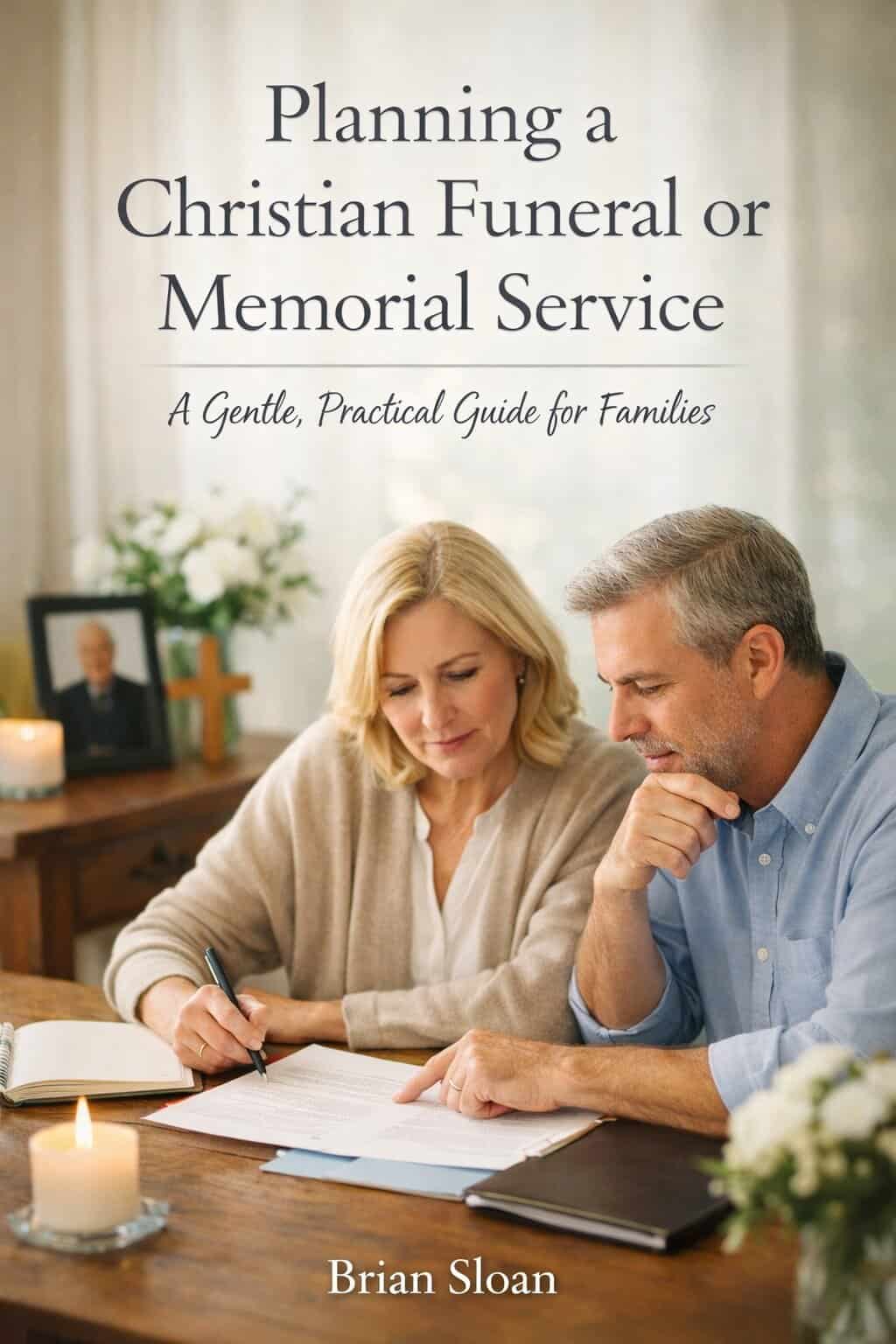
If you’re walking through loss and trying to plan a funeral or memorial service, you may need a more detailed resource – and we have one for you. This gentle, pastor-written guide was created to help carry some of that burden. It walks families through visitation, service flow, music planning, roles and responsibilities, and practical details — all with compassion and clarity.
This planning guide offers step-by-step help for navigating common decisions and understanding what to expect, providing calm structure during a difficult season.
Key Decisions Families Commonly Face
As planning begins, a few core decisions usually rise to the surface.
These may include:
- Where the service will be held (church, funeral home, graveside, or another location)
- Who will officiate or lead the service
- Whether there will be a visitation or viewing
- What music or hymns to include
- Who, if anyone, will share reflections
- Whether the service will be followed by burial or held separately
- If photos or a slideshow will be part of the gathering
Not every family chooses all of these elements. Some prefer a very simple service. Others include several personal touches.
There is no required formula. The goal is to create a meaningful time of remembrance that feels appropriate for your loved one and supportive for those attending.

Who Typically Helps With What
Families are rarely expected to handle everything alone.
Several people usually work together behind the scenes.
The officiant (often a pastor or minister) typically leads the service itself, offers Scripture, and provides spiritual encouragement.
The funeral director helps coordinate logistics such as scheduling, transportation, paperwork, and physical arrangements.
Family members often contribute personal elements — choosing music, gathering photos, selecting speakers, or deciding how the service will reflect their loved one’s life.
If the service includes music or audio-visual elements, musicians or technical helpers may also be involved.
Knowing that each person plays a different role can relieve some pressure. You don’t have to carry every responsibility yourself.
Music, Scripture, and Personal Reflections
Music and Scripture are often among the most meaningful parts of a Christian service.
Songs and hymns can express emotions that words alone cannot. Many families choose two or three selections that reflect faith, comfort, or hope.
Scripture readings anchor the service in God’s promises. Passages about eternal life, God’s presence in suffering, and the assurance of resurrection are commonly included.
Some services also allow time for family or friends to share brief reflections or memories. These moments can be deeply personal and help paint a fuller picture of the person being honored.
Not every service includes all of these elements. Some families prefer simplicity, while others welcome multiple voices. Either approach is perfectly appropriate.
Graveside Services (Brief Overview)
In some cases, burial follows the main service with a short graveside gathering. In other situations, families choose a graveside-only service.
Graveside services are usually shorter and more intimate. They often include Scripture, prayer, and a few closing words before interment.
Weather, travel, and family needs sometimes influence this decision. Again, there is no single “right” way — only what feels most fitting for your circumstances.
A Gentle Word for Families Walking Through Loss
Grief does not move in straight lines.
Some moments feel manageable. Others feel heavy without warning. Planning a service while grieving can be emotionally exhausting.
If possible, allow others to help. Accept offers of support. Take breaks when you need them. And remember that perfection is not the goal.
A Christian funeral or memorial service does not need to be flawless to be meaningful. What matters most is the love that gathers people together and the hope that points beyond this moment.
Take each step as it comes.
A Few Gentle Planning Tips for the First 48 Hours
The first day or two after a loss can feel disorienting. Emotions are heavy, sleep may be disrupted, and decisions can feel overwhelming. During this early window, it helps to slow the pace and focus only on what truly needs attention.
Try not to make every decision at once. Many details can wait. Begin with the basics — contacting close family, choosing a funeral home, and reaching out to a pastor or church if you have one. Writing things down as they arise can help keep your thoughts from spinning.
If possible, designate one trusted person to help communicate with others. This can relieve pressure and give you space to breathe. Accept offers of help, even if it feels uncomfortable. Simple support like meals, errands, or childcare can make a meaningful difference.
Most importantly, give yourself permission to pause. Grief affects the body as well as the heart. Drink water. Rest when you can. Step outside for a few moments of fresh air.
There is no perfect way to walk through these first hours — only one step at a time. Gentle, unhurried decisions are often the wisest ones.
Above all, please know that we are praying for you and your family during this tender season. Grief has a way of touching every part of life, and you don’t have to carry it alone. Lean on those who love you — family, friends, your church community — and allow them to walk beside you. Sometimes the greatest comfort comes not from having all the right words, but from simply being surrounded by caring hearts. Even small moments of support can become quiet reminders that you are not forgotten.
Most of all, we encourage you to lean into your relationship with Jesus Christ. God’s love for you has not changed, even in the midst of loss. He is near to the brokenhearted, and His presence brings strength when yours feels thin. As you take each step forward, may you find comfort in His promises, peace in His nearness, and hope for the future through Christ. You don’t have to be strong on your own — let Him be your strength, your anchor, and your steady hope in the days ahead.


Leave a Reply