
Many Christians quietly wrestle with this question: Is depression a sin?
Not long after the heaviness settles in, feelings of guilt often follow. You may worry that your low emotions mean you’re spiritually failing—or that God is disappointed in you because you can’t “snap out of it.”
Let’s say it clearly at the beginning: depression itself is not a sin.
Yes, we can make choices that contribute to emotional pain, but the condition of depression—whether mild or severe—is not a moral failure. It is suffering. It is weakness. It is a weight. But it is not sin.
And the Bible shows us that God meets His people with compassion right in the middle of it.
Let’s explore what Scripture actually says and why you never need to carry guilt for struggling with depression.
If you’re hurting right now, you’re not alone. Many sincere Christians battle depression — and God’s love for you has not changed one bit. Sometimes it helps simply to pause, breathe, and let Scripture remind you of what your emotions may have trouble believing.
I created a free devotional guide for moments like this. If you need encouragement today, you can download it here-
When Depression Won’t Lift
If prayer feels difficult, your thoughts feel heavy, or hope feels distant, 9 Practical Strategies to Cut Through the Fog of Depression was written for seasons exactly like this. It offers steady, Scripture-centered guidance you can return to day by day.
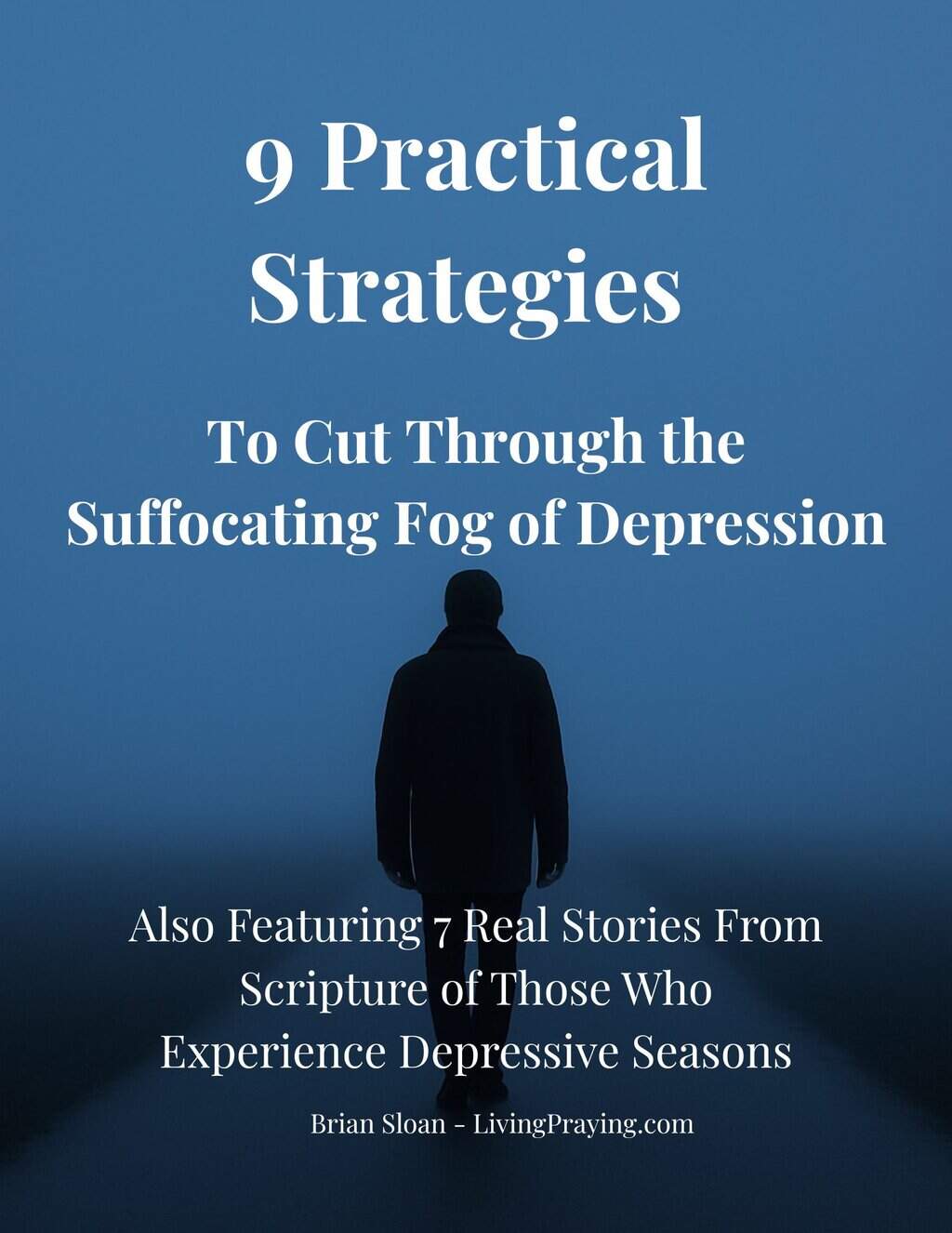
- Clear structure for days when focus and energy are low
- Biblical encouragement without pressure or clichés
- Practical steps rooted in grace, not guilt
- Written pastorally for real-life seasons of struggle
Why Some Christians Assume Depression Is Sin
Many believers have absorbed—often unintentionally—the idea that a strong Christian should always feel upbeat, certain, hopeful, and emotionally steady. When life knocks them off balance, they instinctively assume something must be spiritually wrong. This belief may come from well-meaning church culture, incomplete teaching, or a misunderstanding of what biblical joy actually is.
But nowhere in Scripture does God demand emotional invulnerability.
We live in a fallen world with grief, trauma, pain, sickness, and loss. Our bodies and minds can become overwhelmed. Christians experience the full range of human emotion, including fear, sadness, confusion, and despair. The presence of these emotions does not equal spiritual failure. The Bible never equates emotional distress with sin—and it never demands constant happiness as proof of godliness.
Misreading Verses About Joy
Some of the pressure comes from verses like:
“Rejoice always.” —1 Thessalonians 5:16
This beautiful verse is often misunderstood. Paul wasn’t telling believers to maintain a continuous emotional high or pretend life doesn’t hurt. Biblical rejoicing is an orientation of trust in God—not a forced outward cheerfulness.
If Paul meant we must smile through every agony, he would be contradicting his own example. The same apostle who wrote “Rejoice always” also wrote:
“We were under great pressure… so that we despaired of life itself.”
—2 Corinthians 1:8
Paul’s emotional life was not a straight upward line. And yet he remained faithful, joyful, and deeply loved by God.
Emotional Pain Is Not Evidence of Weak Faith
Here’s the truth:
Sadness is not a sign of spiritual immaturity. Depression is not proof that your faith is broken.
Even the strongest believers have moments when life feels unbearable. Elijah collapsed under the broom tree. David soaked his bed with tears. Jeremiah questioned the day he was born. These weren’t moments of rebellion—they were moments of human exhaustion.
To call these experiences “sin” is to call God’s faithful servants sinful for simply being human.
Misunderstanding Faith and Emotions
Christians often assume that strong emotions—especially difficult ones—must come from a spiritual problem. But this comes from a Western, not biblical, way of thinking. The Bible does not teach that spiritual maturity eliminates emotional struggle. The Psalms alone prove that emotional honesty is part of a healthy, God-centered life.
Sadness Does Not Equal Sin
Depression can make us feel weak, powerless, or out of control. And because we tend to equate weakness with failure, we assume God must feel the same way about us.
But God views weakness very differently.
Paul said:
“For when I am weak, then I am strong.”
—2 Corinthians 12:10
In God’s economy, weakness is not failure—weakness is the place where His strength shines most clearly. The place where you feel the most fragile may be the place where God intends to meet you most powerfully.
Feeling vs. Choosing
Many Christians carry unnecessary guilt because they’ve never learned how to separate emotions from actions.
- Feeling overwhelmed is not sin.
- Feeling numb is not sin.
- Feeling hopeless is not sin.
- Experiencing depression is not sin.
Sin involves choices—rebellion of the will—not the involuntary heaviness that comes with depression.
Depression is a condition, not a decision. Yes, you can choose to submit to dong God’s word. You can submit to christin counseling. You can make decisions about how to get treament for your depression. But for me, I have never just willed myself out of depression. And i have had it several times.
A believer can be fully committed to Christ and still feel crushed by circumstances. They can trust God deeply and still wake up with a heaviness they didn’t choose. They can walk faithfully yet carry a sadness that doesn’t lift easily.
God does not condemn His children for emotional battles. He comforts them through them.
Confusing Feelings With Moral Choices
This is one of the most common spiritual misunderstandings in the church.
We know God calls us away from sinful choices. But we mistakenly apply those expectations to emotional experiences—experiences that are often outside our control.
Depression Is Not a Moral Failure
You didn’t choose to feel depressed any more than you choose a migraine or a stomach virus. Emotions have physical, psychological, hormonal, neurological, and circumstantial roots.
Emotions are responses, not rebellions.
Calling depression “sin” adds guilt to pain. It creates a spiritual burden God never intended you to carry. Could a moreal faulure cause you to be depressed. Yes. But most of the time some moral failure is not the cause of depressioin.
Guilt Makes Depression Worse
When you feel depressed and then tell yourself that God must be angry with you for it, you compound the suffering.
- You hurt emotionally.
- Then you feel guilty for hurting.
- Then you feel ashamed for feeling guilty.
This spiral doesn’t come from the Holy Spirit—it comes from misunderstanding.
God never shames His children into healing. He invites them into rest, comfort, and compassion.
God Meets You in Your Emotions
The Garden of Gethsemane shows us something profound: Jesus Himself experienced anguish so deep that He sweat like drops of blood. That moment wasn’t sinful. It was holy.
If emotional anguish were sinful, Jesus could not have felt it.
Your emotions do not disqualify you from God’s love. They prove your humanity—and highlight God’s tenderness toward you.a decision. Not a transgression.
What the Bible Actually Shows About Depression
If depression were sin, then Scripture would be filled with sinful giants of the faith—because many of God’s most faithful servants walked through seasons of crushing emotional darkness. The Bible never hides this. Instead, it brings their pain into the open so that weary believers today can see that emotional suffering is not a spiritual defect but part of walking with God in a broken world.
The stories of Elijah, David, Jeremiah, Job, Paul, and even Jesus in Gethsemane show us something profound: God does some of His most compassionate work in moments of deep emotional distress. Depression does not disqualify a believer from God’s favor. In fact, Scripture consistently shows Him drawing nearer to the brokenhearted, not pulling away.
Elijah’s Exhaustion and Despair
Elijah’s story may be the clearest biblical picture of emotional collapse. After the explosive victory on Mount Carmel—fire from heaven, a nation turning its head back toward God, and supernatural boldness—Elijah hit an emotional wall so severe that he ran for his life, collapsed under a broom tree, and said:
“I have had enough, Lord… Take my life.”
—1 Kings 19:4
This wasn’t mild discouragement. It was despair. It was exhaustion. It was a moment when Elijah’s emotional reserves were completely depleted.
And how did God respond?
Not with rebuke.
Not with shame.
Not with a lecture about faith.
Instead:
- God let him sleep.
- God sent an angel to feed him.
- God gave him time to recover.
- God gently redirected him, step by step.
There is no hint of condemnation in the passage. No accusation. No correction for “failing spiritually.”
God treated Elijah’s emotional collapse as a human limitation, not a spiritual crime.
God’s response paints a tender picture: when His children are emotionally exhausted, He doesn’t demand that they try harder—He ministers to them with rest, nourishment, and compassion.
This is God’s heart toward every believer facing depression today.

David’s Emotional Brokenness
David—the “man after God’s own heart”—experienced emotional depths that many Christians today would mistakenly label as spiritual failure. Yet David’s raw honesty is woven into the very fabric of Scripture. Over and over, he poured out his pain before the Lord:
“Why, my soul, are you downcast?
Why so disturbed within me?”
—Psalm 42:5
This wasn’t poetic exaggeration. David battled seasons of deep heaviness, anxiety, fear, and spiritual disorientation. He often wrote from caves, running for his life, betrayed by those he trusted, or carrying the weight of profound grief.
Here’s what matters most: God never rebuked David for these emotions. In fact, David’s laments were inspired by the Holy Spirit and preserved as worship. God turned David’s emotional turmoil into Scripture that has comforted millions.
If emotional distress were sinful, then the Psalms—arguably the most honest, soul-baring book in the Bible—would be a record of sin instead of worship. Instead, God welcomes David’s honesty and uses his transparency to teach us how to bring our pain into His presence.
Jeremiah’s Pain
Jeremiah is often called “the weeping prophet” because his ministry was marked by constant rejection, loneliness, national disaster, and personal anguish. His writings include some of the heaviest emotional expressions found anywhere in Scripture.
At one point, Jeremiah cried out:
“Cursed be the day I was born!”
—Jeremiah 20:14
This wasn’t a moment of rebellion—it was the cry of a man carrying unbearable emotional and spiritual weight. And yet God did not condemn Jeremiah. He didn’t silence him. He didn’t tell him to “have more faith.”
God let Jeremiah speak honestly out of the depths of his pain.
Jeremiah’s words were not removed from Scripture for being “too dark.” Instead, they were preserved—on purpose—so that believers who feel overwhelmed or hopeless know they’re not alone. Jeremiah shows us that feeling crushed is not incompatible with belonging to God. If anything, his honesty demonstrates the depth of his relationship with the Lord.
Paul’s Honesty About Suffering
Paul, the great missionary and theologian, openly described emotional and spiritual pressure so severe that he “despaired of life itself.” He wrote:
“We were under great pressure, far beyond our ability to endure, so that we despaired of life itself.”
—2 Corinthians 1:8
This is as transparent as it gets. Paul wasn’t embarrassed to admit that the burden felt unbearable. He didn’t hide it or push it down. Under the inspiration of the Holy Spirit, he recorded it.
If despair were sin, then Paul would have been sinning while writing Scripture.
But of course, that’s impossible.
Paul’s honesty teaches us that deep emotional pain and deep faith can coexist. He wasn’t less spiritual for admitting despair—he was more authentic, more human, and more dependent on God’s strength.
Paul’s words reassure every believer who feels overwhelmed: emotional heaviness is not a sign that you have failed God—it is an invitation to experience His comfort in a deeper way.
All of this teaches us something vital: emotional heaviness is not rebellion. It’s part of being human. And the presence of emotional pain in God’s people—across Scripture—shows that depression is not sin, but suffering that God enters into with compassion.
Why Depression Itself Is Not Sin
The heart of the issue is simple: Depression has many causes, and most of them are not connected to sin at all.
Depression Has Real, Physical Causes
People can experience depression because of:
- Brain chemistry
- Thyroid or hormonal imbalances
- Chronic pain or illness
- PTSD or trauma
- Sleep disorders
- Postpartum shifts
- Medication side effects
- Grief
- Loneliness
- Life transitions
- Caregiver fatigue
These are not spiritual failures. They are realities of life in a fallen world.
Even If Sin Contributes, the Depression Isn’t Sin
Sometimes sinful patterns—bitterness, withdrawal, unhealthy coping—can intensify depression. But those choices are separate from the emotional state that follows.
The cause may be sinful.
The consequence (depression) is not.
Jesus Never Condemned Emotional Brokenness
Not once did Jesus shame someone for feeling overwhelmed, fragile, discouraged, or afraid.
“A bruised reed He will not break.”
—Matthew 12:20
A bruised reed is fragile. Jesus doesn’t snap it off—He protects it.
Guilt About Feeling Depressed Only Makes It Worse
One of the most damaging lies Christians face is the belief that God is disappointed with their emotional state.
Shame Deepens the Darkness
Why Depression Itself Is Not Sin
At the core of the question is a truth many believers have never been taught clearly: depression is a condition, not a moral choice. It affects the mind, body, and emotions in complex ways—ways that cannot simply be reduced to “You should have more faith” or “You shouldn’t feel that way.”
Sin is rooted in the will. Depression is often completely outside of it.
To call depression sin is to misunderstand both human nature and the compassionate heart of God.
Depression Has Real, Physical Causes
Depression is often driven by factors that have nothing to do with spiritual rebellion. Human beings are physical, emotional, and spiritual creatures, and all three parts affect one another. When the body or brain is under strain, the heart and emotions often follow.
People can experience depression because of things like:
- Brain chemistry and neurotransmitter imbalances
- Thyroid issues or other hormonal changes
- Chronic pain or chronic illness
- PTSD, trauma, or long-term stress
- Sleep disorders or prolonged sleep deprivation
- Postpartum hormonal shifts
- Medication side effects
- Grief after loss
- Loneliness or isolation
- Life transitions such as retirement, empty nest, job changes
- Caregiver fatigue or compassion exhaustion
These are not spiritual failures. They are realities of life in a fallen world.
If someone breaks a bone, we don’t shame them for being injured. If someone has diabetes, we don’t suggest they’re spiritually weak. Depression often functions the same way: it’s a condition that needs care, not condemnation. Physical suffering is part of the human experience, and emotional suffering is no different.
God understands the complexity of how we’re made—and He never equates emotional struggle with sin.
Even If Sin Contributes, the Depression Isn’t Sin
There are times when sinful behavior can worsen emotional distress—bitterness can harden the heart, isolation can deepen sadness, and unhealthy coping can intensify despair. But even in those cases, it is crucial to distinguish between:
1. The sinful choice
and
2. The emotional condition that results
They are not the same thing.
For example:
- Bitterness can lead to heaviness.
- Substance misuse can lead to emotional instability.
- Unresolved guilt can create internal turmoil.
In those moments, repentance may be appropriate for the choice, but not for the feeling. The feeling is a symptom, not a transgression.
It is dangerously unbiblical to label depression itself as sinful just because sin may have played a part somewhere in the story. If that were true, every consequence of every bad choice would automatically become “sin”—and Scripture never teaches that.
The cause may be sinful.
The consequence—the depression—is not.
God does not ask you to repent of a condition you did not choose.
Jesus Never Condemned Emotional Brokenness
One of the clearest truths of the Gospels is this: Jesus consistently moved toward emotionally hurting people, not away from them. He never shamed the anxious, the grieving, the fearful, or the discouraged.
Not once do we hear Him say:
- “Get it together.”
- “You shouldn’t feel that way.”
- “If you trusted Me more, you wouldn’t be hurting.”
Instead, Scripture describes His posture like this:
“A bruised reed He will not break.”
—Matthew 12:20
In the ancient world, a reed bent and bruised was good for nothing. It was fragile, easily crushed, hardly worth keeping.
But Jesus handles bruised people differently.
A bruised reed is fragile… and He refuses to snap it.
A smoldering wick is barely hanging on… and He won’t snuff it out.
Jesus moves gently toward the vulnerable, not forcefully against them.
This is who He is:
Protector of the fragile. Comforter of the weary. Healer of the brokenhearted.
If Jesus doesn’t call emotional brokenness “sin,” neither should we.
But that’s not grace speaking—that’s fear.
Depression Is a Condition, Just Like Any Other Illness
If you had a kidney disease, heart issue, or broken bone, would you feel guilty for that? Of course not.
Depression is no different. It’s a real condition that requires compassion, care, and sometimes medical attention—not condemnation.
How Christians Can Respond Faithfully to Depression
If depression isn’t sin, what do we do with it?

Depression Is a Condition that Can Affect Anyone
One of the most freeing truths for hurting Christians is this: depression is a real condition, not a moral diagnosis. We readily accept that the body can experience sickness, weakness, or breakdown—yet we often forget that the brain and emotions are part of the body too. When something in the mind malfunctions or becomes overwhelmed, it should be treated with the same compassion we extend to physical suffering.
If you had kidney disease, heart issues, or a broken bone, you wouldn’t feel guilty. You wouldn’t repent of it. You wouldn’t assume God was disappointed in you because your body stopped functioning perfectly.
Depression is no different.
It can stem from exhaustion, neurochemistry, trauma, or physical strain. It can appear suddenly or slowly creep in over years. It can be mild, seasonal, circumstantial, or severe. But in every case, it is a condition, not a sin.
And because it’s a condition:
- It deserves care, not criticism.
- It may need treatment, not self-blame.
- It requires compassion, not condemnation.
Shame never heals anything. Grace does.
God’s posture toward the depressed is the same as toward anyone who is physically sick: tender, present, patient, and full of mercy.
How Christians Can Respond Faithfully to Depression
If depression isn’t sin, what does a faithful response look like? Scripture gives us a pattern—one rooted not in pretending we’re okay, but in bringing our honest need before a compassionate Savior.
Run to Jesus, Not Away From Him
Depression can make spiritual practices feel impossible. You may sit with your Bible and feel nothing. You may pray and feel like your words fall flat. You may question whether God is listening. None of that disqualifies you from His love.
Some days you won’t have eloquent prayers. You may only manage a few words:
“Lord, hold me today.”
“Jesus, stay near.”
“Father, I need You.”
These simple cries honor God because they come from honesty.
Jesus gave this invitation specifically for the emotionally overwhelmed:
“Come to me, all you who are weary and burdened, and I will give you rest.”
—Matthew 11:28
He didn’t say “perform for Me,” “impress Me,” or “fix yourself first.”
He said come.
Seek Emotional and Medical Support
Faith and help are not enemies. God works through people, wisdom, medicine, and community.
Seeking help is not a sign of weak spirituality—it is a sign of wisdom and humility.
Helpful avenues include:
- Counseling or therapy
- Medical evaluation to check for hormonal, chemical, or neurological factors
- Medication, when appropriate
- Pastoral counseling or biblical encouragement
- Trusted Christian friends who can walk with you
- Support groups for shared struggles
God often uses these practical tools as extensions of His care. You’re not less of a Christian for needing support. You’re human—and humans need each other.
Let the Psalms Speak When You Can’t
When your own words feel impossible to form, the Psalms give you God-approved language for your pain. These scriptures are full of sadness, hope, wrestling, and trust—exactly the emotions that accompany depression.
Some of the most comforting include:
- Psalm 34 — God is close to the brokenhearted
- Psalm 42 — Why are you downcast, O my soul?
- Psalm 73 — My flesh and my heart may fail
- Psalm 143 — My spirit grows faint within me
These Psalms remind you that emotional struggle is not a spiritual anomaly. God invites you to pour out your heart—even when your heart feels empty.
Stay Connected to Others (Even When You Don’t Feel Like It)
One of depression’s strongest pulls is isolation. It convinces you that you’re a burden, that no one understands, or that you’d be better off alone.
But isolation feeds depression. Community weakens it.
You don’t need to be talkative, cheerful, or “yourself.” You don’t need to perform socially. You don’t need to be the strong one.
Even small steps matter:
- Texting a friend
- Sitting quietly in a room with family
- Attending church even if you say little
- Letting someone pray for you
- Sharing coffee with a trusted friend
Presence—not performance—is what helps.
God designed healing to happen in community. Depression wants to pull you inward and away from people who can help. Faithfulness sometimes looks as simple as refusing to walk alone.
When Sin Is Connected: Understanding the Difference
This is an important distinction many Christians never hear clearly. The goal isn’t to blame anyone for their pain, but to bring clarity and freedom. There are moments when sinful patterns can worsen emotional distress—but that does not make depression itself sinful. Sin and suffering interact, but they are not identical.
Understanding the difference helps believers avoid unnecessary guilt and move toward genuine healing.
Sin Can Sometimes Contribute
Sometimes emotional pain is made worse by choices such as:
- Unforgiveness that poisons the heart
- Self-destructive habits that damage emotions
- Isolation when God offers community
- Ignoring wise counsel that could provide relief
- Escaping into harmful behaviors instead of facing truth
In these cases, repentance may be necessary—not because the depression is sinful, but because certain choices can intensify it.
It’s similar to how ignoring medical advice can worsen a physical condition. The worsening is not “sin”—but the refusal to follow wisdom might be.
Even then, the emotional heaviness that follows is not something to confess—it is something to receive compassion for.
The sin may have been a choice.
The depression is not.
Depression Can Tempt Us Toward Sin
This is where many Christians feel the sharpest guilt—because depression often carries powerful temptations:
- Doubt
- Despair
- Withdrawal
- Hopeless thoughts
- Irritability or harsh reactions
- A desire to give up spiritually
But temptation is not sin.
Feeling tempted toward hopelessness does not mean you’ve failed God. Depression can push you toward dark thoughts that feel foreign to your normal self. That’s not evidence of moral failure—it’s evidence of heavy suffering.
Scripture says:
“Jesus was tempted in every way, just as we are—yet he did not sin.”
—Hebrews 4:15
If Jesus was tempted, then temptation itself cannot be sin.
Temptation is a battle, not a transgression.
Depression often magnifies temptation because the mind is tired, the body is depleted, and emotions feel frayed. God understands this. He does not condemn you for the battle raging inside.
Being tempted by despair is not sin—it is part of the struggle of being human.
What Confession Looks Like (If Needed)
When sin is involved, confession is healing and freeing. But confession should always target the choice, not the condition.
Examples of honest, biblical confession might sound like:
- “Lord, I’ve withdrawn when I needed to reach out for help.”
- “Father, I’ve ignored Your presence and tried to numb myself.”
- “I’m sorry for the hurtful words I spoke out of my pain.”
- “Lord, rid my heart from bitterness.”
symptoms of suffering.
Depression is pain, not rebellion.
You confess choices—not conditions.
What God Wants You to Know If You’re Depressed
If someone only reads one part of this entire article, this should be it.
Depression can convince you that God is distant or disapproving. But Scripture paints the exact opposite picture. God’s heart toward the hurting is full of compassion, patience, and nearness.
God Is Not Disappointed in You
Your emotional state is not a report card of your spiritual maturity. God does not love the “happy version” of you more than the “depressed version” of you.
He is not scanning your emotions to determine whether you’re worthy of His presence. In fact, the Bible says:
“The Lord is close to the brokenhearted.”
—Psalm 34:18
Brokenhearted people are not scolded by God—they are held by Him.
He sits with the weary.
He comforts the crushed.
He embraces the sorrowful.
His compassion is not tied to your performance—it flows from His character.
Your Feelings Don’t Change Your Standing in Christ
Depression often clouds the truth. It can make God feel distant even when He’s near. It can make you feel unworthy even when Christ has made you righteous. It can make salvation feel fragile even though it rests on the unshakeable foundation of the cross. If you are a born again follower of Jesus Christ, your standing in Christ is still a loved child of God even if you are depressed.
Your standing before God is not based on:
- your emotions,
- your energy level,
- your mental clarity, or
- your sense of spiritual strength.
Your standing in Christ is anchored to His finished work—not your fluctuating feelings.
You may feel like you’re hanging by a thread, but Christ is holding you with both hands.
You’re Not Alone, Even if You Feel Alone
Depression often whispers lies that feel true:
- “God has forgotten you.”
- “People don’t care.”
- “You’re too much.”
- “You’re too weak.”
- “No one understands.”
But Scripture cuts through those lies with a single promise:
“So do not fear, for I am with you.”
—Isaiah 41:10
Your feelings may come and go, but God’s presence does not.
Your emotions may rise and fall, but His faithfulness remains steady.
Your hope may flicker, but His grip on your life never loosens.
God stays. He holds. He keeps. He carries.
And He never walks away from you in your lowest moments.
What the Church Gets Wrong—and How We Can Do Better
The church should be one of the safest places on earth for those battling depression. And sometimes it is. But in many congregations, emotional suffering still carries an unspoken stigma. People feel pressure to appear strong, joyful, or “blessed” even when they’re crumbling inside. We can—and must—do better.
We Must Stop Treating Depression as a Character Flaw
Many believers have been hurt by oversimplified spiritual advice:
- “Just pray more.”
- “Read your Bible and you’ll feel better.”
- “If your faith were stronger, this wouldn’t happen.”
These statements—often spoken with good intentions—can unintentionally heap shame onto an already hurting heart. Depression is not caused by a lack of discipline or spiritual passion. It is not solved by forcing a smile, trying harder, or “thinking positive thoughts.”
Simplicity is not compassion.
Real compassion listens, sits with the hurting, and walks with patience.
Instead of assuming depression equals spiritual failure, the church must learn to respond the way God responds: with tenderness, patience, and understanding.
We Need to Be Safe for Strugglers
A believer battling depression should never feel pressure to hide their pain or pretend they’re okay. Yet many do, because they fear judgment or misunderstanding. Authentic Christian community is not about perfection—it’s about presence.
To be a safe place, the church must:
- Allow honest conversations
- Avoid quick fixes and clichés
- Create space for lament
- Offer prayer that is gentle, not forceful
- Encourage fellowship without demanding emotional performance
Weakness isn’t a threat to the church—it’s what makes community real. When believers feel safe enough to say, “I’m struggling,” the church begins to reflect the heart of Christ.
We Should Encourage Professional Help
For too long, mental health treatment has carried an unnecessary stigma in Christian circles. But caring for the mind is just as biblical as caring for the body. God often works through doctors, counselors, medication, and therapy the same way He works through pastors and prayer.
Seeking help is not worldly.
It is wise stewardship of the life God entrusted to you.
Believers should feel just as free to seek counseling or medical evaluation for depression as they would for high blood pressure or a broken arm. The church can support this by speaking openly about mental health and celebrating the courage it takes to reach out for help.
Conclusion: Depression Is Not Sin—It’s Suffering, and Jesus Meets You There
So, is depression a sin? No. Absolutely not. Depression is not a failure of faith, a rebellion of the heart, or a sign of God’s displeasure. It is part of living in a fallen world where bodies break, minds grow weary, relationships wound us, and life sometimes feels heavier than we can bear.
God does not condemn His children for being overwhelmed.
He draws near to them.
If you’re walking through depression today, don’t carry shame on top of your pain. Jesus does not shame you. He does not scold you for struggling. He comes to you with gentleness, patience, and compassion.
He welcomes you just as you are—tired, discouraged, numb, weary—and offers rest no one else can give.
You do not walk this path alone.
Christ is near.
Help is available.
Hope is real—even if you cannot feel it right now.
And in the moments when you feel like you’re barely holding on, remember: He is holding you—steady, faithful, and unfailing—even in the darkness.

Leave a Reply