

Introduction
So, what does the Bible say about depression? Well, the Bible actually does not use the modern clinical word depression. Yet anyone who reads Scripture carefully soon discovers that the emotional experience we now describe by that word is present throughout its pages.
The Bible speaks honestly about despair, heaviness of soul, emotional exhaustion, fear, sorrow, and seasons when life feels unbearable. It does not sanitize these experiences, nor does it treat them as spiritual embarrassments.
For many Christians, depression creates a painful internal conflict. They believe in God, trust His promises, and sincerely desire to follow His will—yet they find themselves struggling with sadness, numbness, anxiety, or emotional darkness that does not quickly lift. Beneath the surface, a deeper question often forms: If my faith is real, why do I feel this way?
That question is not theoretical for me. I have walked through two significant seasons of depression in adulthood. One occurred as a young 30 yr old minister in a period where I was seeking God’s direction and trying to follow His will for my life. The other came more than two decades later, in my mid-fifties, while serving as a full-time minister—experienced, committed, and still actively walking with God. In neither season was I abandoning my faith. In neither season was I running from God. Yet depression was very real.
Scripture makes room for this reality. The Bible does not present depression as a simple moral failure or reduce it to a single cause. Instead, it portrays emotional suffering as something that can arise from many sources—emotional, physical, relational, and sometimes spiritual—while showing that faithful people can experience deep darkness without forfeiting their relationship with God.
To understand what the Bible truly says about depression, we must listen carefully to its stories, its prayers, and even its silences—not just its commands.
Scripture itself acknowledges this tension of trying to trust God and also becoming depressed. The psalmist asks, “Why, my soul, are you downcast? Why so disturbed within me?” (Psalm 42:5). Job curses the day of his birth under unbearable sorrow (Job 3:11). Jeremiah speaks of his heart being faint within him (Lamentations 1:20). These are not the words of unbelievers, but of people who knew God and still suffered deeply.
The Bible Doesn’t Use the Word “Depression” — But It Describes It Honestly
One common objection in discussions about depression and faith is that the Bible never uses the word depression. That observation is technically true, but it misses the point. Scripture was not written in modern psychological language. It describes human experience using relational, emotional, and poetic terms that often reach deeper than clinical labels.
The Bible speaks of souls that are “downcast,” hearts that are “overwhelmed,” spirits that are “broken,” and minds that are “troubled.” Scripture uses this language repeatedly:
“My soul is overwhelmed within me.” (Psalm 61:2) It records prayers that sound more like cries than confident declarations. Entire psalms are devoted to confusion, despair, and the absence of felt joy—sometimes without tidy resolution.
“Why are you cast down, O my soul?” (Psalm 42:5)
“My spirit grows faint within me; my heart within me is appalled.” (Psalm 143:4)
“A broken spirit who can bear?” (Proverbs 18:14)
These descriptions are not rare exceptions. They are woven into the normal spiritual vocabulary of Scripture. God did not preserve these passages as warnings against weak faith, but as honest testimony of life in a fallen world. Emotional suffering is not foreign to biblical faith.
Just as importantly, Scripture often does not explain why the suffering exists. It does not always identify a clear cause or show immediate emotional relief. Many biblical writers continue trusting God while still feeling crushed inside. Faith and emotional darkness are shown coexisting, sometimes for long stretches of time.
Before asking how to fix depression, Scripture invites us first to acknowledge it—to name it honestly and recognize that God is not threatened by truthful sorrow. In fact, He has already given it a voice in His Word.
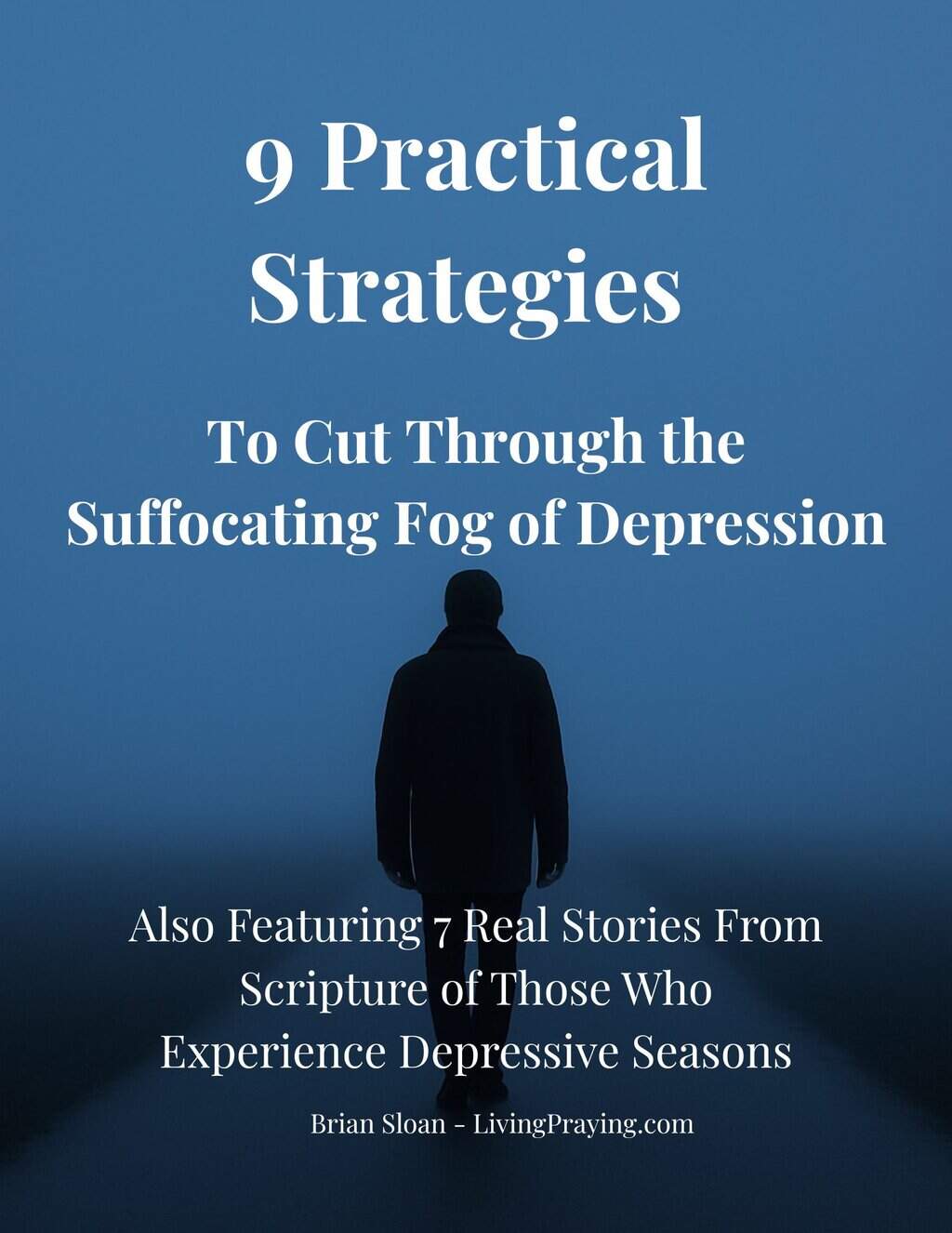
This Christ-centered bundle includes two closely connected resources focused specifically on depression. The first is a brief companion PDF designed for immediate reading when focus or energy is low. The second is a longer devotional guide (9 Practical Strategies to Cut Through the Fog of Depression) that offers a more detailed, structured walk through Scripture over time.

David — A Faithful Man Who Lived With Prolonged Emotional Darkness
If Scripture only contained brief references to emotional pain, depression might be easier to dismiss as marginal. But when we come to David, that dismissal becomes impossible.
David is remembered for courage, leadership, and deep devotion to God. He is called a man after God’s own heart. Yet the Psalms reveal a far more complex inner life. Again and again, David speaks of being overwhelmed, sleepless, fearful, and weighed down in his soul. These are not isolated moments. They appear across many seasons—during danger, betrayal, loneliness, and even times of outward success. David gives voice to this suffering explicitly:
“My tears have been my food day and night” (Psalm 42:3)
“I am weary with my groaning; all night I flood my bed with tears” (Psalm 6:6)
“My strength is dried up like a potsherd” (Psalm 22:15)

What is striking is not only that David felt this way, but that God allowed these prayers to stand in Scripture without correction. David asks why God feels distant. He wonders how long the darkness will last. He describes his strength as dried up and his joy as gone. At times, he sounds less like a triumphant king and more like a weary man barely holding himself together. And yet these words are not rebuked. They are preserved. These psalms were not edited out of Scripture; they were given to Israel as worship.
This tells us something essential: emotional honesty is not a violation of faith. David does not pretend his way through suffering. He brings his whole self—fear, confusion, exhaustion, and sorrow—into God’s presence. His prayers are not polished. They are raw, relational, and deeply human.
David’s emotional struggles also resist simple explanations. Sometimes sorrow is connected to sin and its consequences. Other times it arises from prolonged stress, danger, grief, or isolation. In many psalms, no cause is given at all. The pain simply exists. Scripture does not force a diagnosis or demand that every season of darkness be traced to spiritual failure.
David’s life challenges the assumption that if faith is “working,” emotional darkness should lift quickly. He trusted God sincerely, worshiped passionately, and still experienced seasons where joy felt distant. Faith did not remove his vulnerability. It gave him language to survive it.
Depression Isn’t Always “One Thing” — and It Isn’t Proof You’re Not Spiritual
Scripture makes room for emotional suffering in faithful people, and it shows that heaviness can have more than one contributing factor.
Emotional & Circumstantial Weight
- Grief, loss, prolonged stress, fear, loneliness, disappointment
- Heaviness that can linger even when you’re trying to do “the right things”
- Often includes racing thoughts, low motivation, or a sense of being overwhelmed
Scripture examples: Psalms of distress and “downcast” prayers (Psalm 42:5; Psalm 61:2).
Physical & Bodily Factors
- Sleep disruption, fatigue, chronic stress effects, illness, hormonal or neurological factors
- Emotional darkness can be intensified when the body is depleted
- Wise care can include rest, routine, counseling, and medical evaluation when needed
Scripture examples: God addressed Elijah’s exhaustion with sleep and food before instruction (1 Kings 19:4–8).
Overwhelming Pressure — Even in Faithful Obedience
- Moments where the load feels beyond your ability to endure
- Depression can arrive without a neat explanation or a single “cause”
- You may still be serving, believing, and obeying — while feeling crushed inside
Scripture examples: Paul “despaired of life itself” under intense pressure (2 Corinthians 1:8–9).
Spiritual Discouragement Can Be Real — Without Being the Whole Story
- Seasons where God feels distant, prayer feels difficult, or hope feels thin
- Spiritual attack or inner accusation can deepen the darkness
- But depression is not automatically a verdict of “weak faith”
Scripture examples: Honest lament is preserved in Scripture (Psalm 13:1–2), and deep sorrow can coexist with obedience (Matthew 26:38).
Gentle note: If your symptoms are persistent, worsening, or include thoughts of self-harm, seek help right away from a medical professional or counselor. Getting help is not a spiritual failure—often it’s part of God’s provision for your care.
Elijah — Depression After Victory, Exhaustion, and Faithful Obedience
If David shows us prolonged emotional sorrow, Elijah shows us something just as important: depression can follow obedience, courage, and even great spiritual victory.
Elijah stands alone against the prophets of Baal. He prays boldly. God answers unmistakably. Fire falls. Truth is vindicated. It is one of the most decisive spiritual victories in Scripture.
And almost immediately afterward, Elijah collapses.

A single threat sends him running for his life. The prophet who stood fearless before a nation now finds himself alone, frightened, and emotionally spent. He asks God to take his life. Scripture records Elijah’s words plainly: “I have had enough, Lord… Take my life” (1 Kings 19:4).
This is not the language of spiritual rebellion. It is the language of profound exhaustion.
Elijah’s despair did not come from compromise. It came after sustained pressure, prolonged stress, intense responsibility, and massive emotional output. He had been living on adrenaline and obedience for a long time. When the crisis passed, the cost surfaced.
God’s response is deeply revealing. There is no rebuke. No lecture. No correction. God addresses Elijah’s physical and emotional depletion first—food, rest, quiet presence. God provides sleep, nourishment, and gentle presence before instruction (1 Kings 19:5–8). Only later does God speak—not in wind, earthquake, or fire, but in a low whisper (1 Kings 19:11–12). Only later does He gently reorient Elijah’s perspective and call him forward again.
Scripture treats Elijah not as a failure, but as a weary servant. His calling is not withdrawn. He is not discarded. He is cared for.
This matters for anyone who assumes depression must mean spiritual failure. Sometimes despair comes not because we have run from God, but because we have been faithfully running with Him for too long without rest.
Paul — When Faith Does Not Prevent Despair
The New Testament does not replace emotional honesty with triumphal confidence. When we listen to Paul the Apostle, that becomes clear.
Paul openly admits that he was “burdened beyond strength” and “despaired of life itself.” Paul writes, “We were under great pressure, far beyond our ability to endure, so that we despaired of life itself” (2 Corinthians 1:8).This is not exaggeration. It is an unguarded confession of despair from a man who knew his calling and followed Christ wholeheartedly.
Paul’s despair arose in the middle of obedience, suffering, and responsibility—not spiritual drift. He does not frame it as failure. He speaks honestly about it and reflects on how it deepened his reliance on God.
Paul dismantles the idea that spiritual maturity produces emotional invulnerability. Faith does not make us immune to despair. It anchors us while we are in it. Paul goes on to say that this suffering taught him “not to rely on ourselves but on God who raises the dead” (2 Corinthians 1:9).
Taken together, David, Elijah, and Paul give us a fuller biblical picture. Emotional suffering is not limited to one season of life, one spiritual maturity level, or one type of calling. Scripture does not present depression as a single problem with a single explanation—but as a human experience shaped by many factors.
Depression Is Not One Thing — And It Is Not Proof You Aren’t “Spiritual Enough”
One of the quiet burdens many Christians carry when they are depressed is the assumption that something must be spiritually wrong with them. They may never say it out loud, but the thought lingers: If I were more spiritual—if I prayed more, trusted more, believed better—I wouldn’t feel this way. That belief is common, but Scripture does exactly teach that, and it often deepens suffering rather than relieves it.
The Bible does not present emotional health as a direct measurement of spiritual maturity. If it did, David, Elijah, and Paul would all stand condemned by their own words. David loved God and still wrote from seasons of heaviness. Elijah obeyed God courageously and still collapsed into despair. Paul followed Christ with unwavering commitment and still experienced great despair. Scripture consistently separates a person’s standing with God from their emotional state. Faithfulness is measured by trust and obedience—not by the absence of emotional pain.
Scripture never makes emotional pain a measure of faith. Jesus Himself warned that sorrow would accompany life in this world (John 16:33). The righteous are not promised constant emotional relief, but God’s nearness: “The Lord is close to the brokenhearted” (Psalm 34:18).
This distinction matters because depression often attacks confidence before it attacks theology. When sadness lingers, motivation fades, or joy feels inaccessible, believers may begin to doubt not only their emotional stability but their spiritual authenticity. Over time, depression becomes layered with guilt, shame, and fear—burdens the Bible never intended believers to carry. Scripture makes room for a freeing truth: a Christian can be deeply sincere, deeply faithful, and deeply depressed at the same time.
That does not mean the spiritual life is irrelevant. It means it is not the only factor.
Depression Can Have Multiple Causes—Sometimes at the Same Time
One of the most damaging assumptions Christians make about depression is that it must have a single cause—and therefore a single solution. Scripture doesn’t seem to support that view. The Bible portrays human beings as whole persons—body, mind, and spirit intertwined. Because of that, depression is rarely neat or singular in its origin.
Emotional and circumstantial strain is a real contributor for many people. Prolonged stress, grief, loss, fear, loneliness, betrayal, disappointment, or heavy responsibility can wear down emotional resilience over time. David’s sorrow often flowed from danger and isolation. Paul’s anguish came under overwhelming pressure. Scripture does not dismiss these realities or shame believers for being affected by them. It treats emotional pain as something to bring into God’s presence, not something to explain away.

Physical and medical factors can also play a significant role. Fatigue, sleep disruption, chronic stress, illness, hormonal changes, neurological chemistry, and long-term burnout can profoundly affect a person’s mood and emotional stability. Elijah’s story is a clear biblical reminder that spiritual strength does not cancel physical limits. Before God addressed Elijah’s perspective, He addressed his depletion—rest, nourishment, and quiet care. That order is not incidental. It reflects God’s understanding of how closely the body and soul are connected.
Scripture consistently affirms the unity of body and soul. Even Jesus acknowledged physical limits when He urged His disciples to rest (Mark 6:31). Proverbs affirms the physical dimension of emotional suffering: “A cheerful heart is good medicine, but a crushed spirit dries up the bones” (Proverbs 17:22).
And yes, spiritual factors can matter greatly—but they should be handled with care. Spiritual discouragement, temptation toward despair, seasons when God feels distant, or intensified inward accusation can deepen suffering. The psalms give voice to this without embarrassment. Scripture does not deny the spiritual dimension; it simply refuses to treat it as the explanation for every case of depression.
In real life, these categories often overlap. Emotional strain can affect the body. Physical depletion can magnify fear. Spiritual discouragement can deepen the sense of isolation. Wisdom lies not in oversimplifying, but in paying attention to the whole person and refusing to place all the weight on one category.
Seeking God Intimately Without Turning Depression Into a Verdict
Because the spiritual life matters, it is right—and deeply biblical—to seek God in an intimate, honest way during depression. Scripture invites prayer that is real rather than polished. It allows lament. It welcomes questions. It shows believers bringing sorrow into God’s presence without pretending it is something else.
But seeking God does not mean assuming depression is evidence of an enormous spiritual failure. It is a relationship meant to sustain us when strength is low. The spiritual life should support healing, not shoulder the blame for suffering.
This balance is crucial. When believers are told—explicitly or implicitly—that depression must be rooted in spiritual deficiency, they often stop being honest. They hide symptoms. They force religious language over unresolved pain. And in doing so, they become more isolated, not more faithful.
Scripture offers a better way. It allows prayer and rest, Scripture and wise counsel, faith and medical care to exist together without competition. God often works through multiple means at once, and none of them diminish His presence or power.
Depression is not a simple spiritual problem to be corrected. It is a form of suffering that calls for patience, truth, care, and grace. Seeking God deeply during depression is right and necessary—but it should be done from a place of trust, not self-accusation. When this distinction is clear, faith becomes an anchor instead of a measuring stick, and believers are freed to pursue healing without carrying the false weight of condemnation.
Two Seasons of Depression While Following God’s Will
In both major seasons of adult depression I have experienced, I was sincerely trying to follow God’s will.
In my early thirties, I was seeking direction and purpose. I was praying, reading Scripture, and asking God to lead me. Yet a heavy emotional fog settled in. Motivation drained. Joy felt distant. What troubled me most was the confusion—believing God was good while feeling internally weighed down.
More than twenty years later, in my mid-fifties, depression returned while I was serving as a full-time minister. This time it did not come with uncertainty about my faith or calling—and I still cannot fully explain why it came at all. I was serving, living life, and yet depression arrived without a clear cause. Experience and theology did not prevent it.
In both seasons, I learned from each but couldn’t tell you the exact cause of either. However, one major part that my physician was quite sure of is that my family history. All the way back to my great grandparents my family has had history of some major clinical depression. So, there can definitely be inherited genetic traits or predispositions toward depression.
Also, emotional strain, physical weariness, and spiritual discouragement can intertwine. Paying attention to all three—without shame—was part of healing.
Depression did not remove God’s presence, even when I could not feel it clearly. His faithfulness often showed up not as emotional relief, but as endurance, wise counsel, rest, medical insight, and steady support.
Depression does not disqualify a believer. It does not revoke calling. It does not negate faith.
What the Bible Does Not Say About Depression
The Bible does not say depression is proof of weak faith.
It does not teach that depression is always caused by personal sin.
It does not promise instant relief through effort or prayer.
It does not imply that seeking medical help is a lack of trust in God.
And it does not say God withdraws His love from those who are depressed.
Much suffering is intensified not by depression itself, but by what people think it means. Scripture removes that burden.
Where the Spiritual Life Still Matters in Depression
The spiritual life matters deeply in depression—but not as a blunt instrument.
Prayer becomes honest presence, not performance.
Scripture becomes companionship, not correction.
Community becomes support, not pressure.
God’s presence is not measured by emotional relief. Jesus Himself experienced overwhelming sorrow: “My soul is overwhelmed with sorrow to the point of death” (Matthew 26:38). His prayer in Gethsemane shows that deep anguish and perfect obedience can exist at the same time.Even Jesus Christ experienced overwhelming sorrow without immediate relief. Faith does not always remove darkness, but it anchors us within it.
Conclusion
The Bible does not offer simplistic answers to depression. It offers something better: honesty, permission, and presence. Faithful people suffer. God walks with them. Sometimes healing is slow. Sometimes it requires help. But it is never a walk away from God.
That truth alone is hope enough to keep going.
Scripture assures believers that suffering does not separate them from God’s love: “Neither death nor life… nor anything else in all creation will be able to separate us from the love of God in Christ Jesus our Lord” (Romans 8:38–39).


Leave a Reply